Intro
/ 01 — 2023—
Research, photography,
sound & installation
The Camara Obscura
Memory, light & sound
The experimental project research The Camara Obscura - Decoding and Reprocessing of Memories is part of transdisciplinary research, involving photography, noise, physics, semiotics, neuroscience and psychology, on the rescue of memories through photography and its decoding.
Where it began
When I was around five years old, I began to have recurring visions of a family wearing gas masks. This image would appear specifically whenever I looked toward my family’s house down the hallway. The vision of the gas mask family always seemed to coincide with moments when bad things were happening in my life. Because of this, I came to associate that image with deeply negative feelings. Experiencing these visions was painful, and I often had nightmares about this gas mask family — they robbed me of peace of mind.
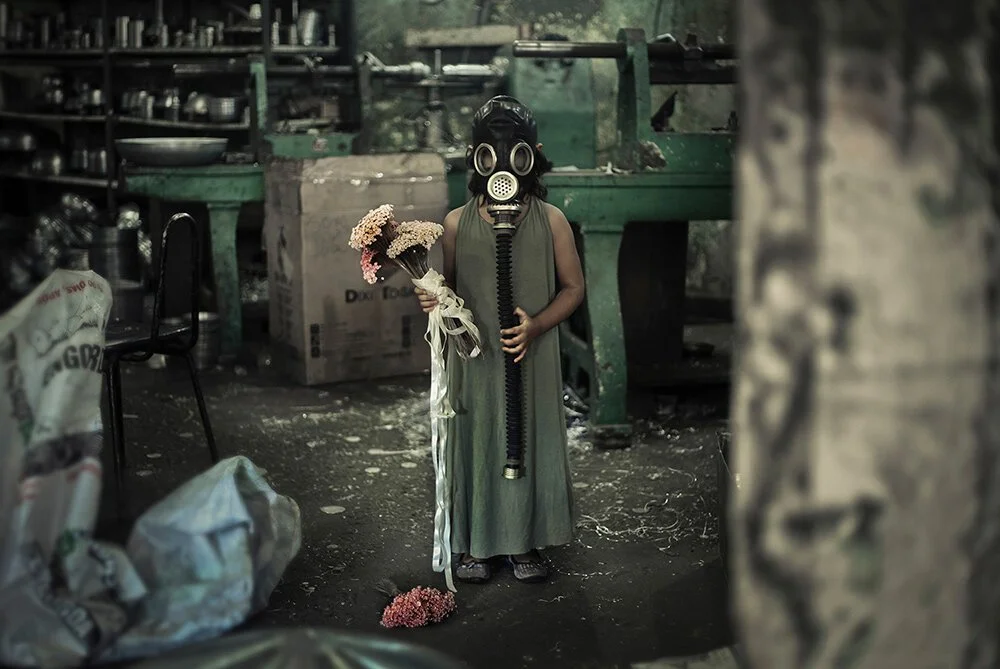
When I was 23, I decided to transform this haunting image into a staged photograph. After finding the models for the shoot, there was no doubt in my mind that I would give them a happy ending. I had lived for too long with the suffocating presence of this heavy-masked family and all the sorrow attached to them. The turning point came when I created and photographed The Gas Mask Girl (2012) — the image shown above. In photographing the girl wearing the gas mask, I borrowed her presence to help me process and purge the emotional weight carried by those visions.
The experience was liberating. It felt as though I had finally removed the filter of my own imaginary gas mask and could breathe freely. I allowed myself to be “contaminated” by this staged girl — and through her, I stepped into a new phase of life, even though the chaos around me remained. That photograph definitively freed me from the ghostly visions of the gas mask family.
I believe that transforming my vision into an object — in this case, a photograph — enabled me to reprocess my past experience and the pain attached to it. Eloa, the girl who posed for the image, became a mirror of myself: she was about the same age I had been when the visions first began. I wanted Eloa to know how important she was in my life, because she offered her presence and seriousness so that together, we could complete this act of catharsis.
This photograph is the starting point of Camara Obscura: if an image could release a memory that had haunted me since childhood, could photography become a tool to reprocess other people’s memories as well?
Self-portraits
“A Diary With Memories That I do Not Have” initiated in 2010. I started in photography with self-portraits and these symbolizes for me a catharsis sphere. In photography, began a unconsciously need to expose situations, trauma disorders, depression and phobias that I possessed and at the time did not know how to express them. It was also when I had contact and identification with the known “suicide photographers”, specifically Francesca Woodman and Diane Arbus. Much has been revealed through this process and then the self-portraits were used as the basis of psychological treatments, specifically with psychodrama techniques ( Jacob Levy Moreno – 1925) and EMDR (Francine Shapiro – 1987).
Camara Obscura extends this personal method to others: the self-portrait as a desensitization process becomes the basis of the work with volunteers who share their stories of trauma.
A Diary With Memories That I Do Not Have →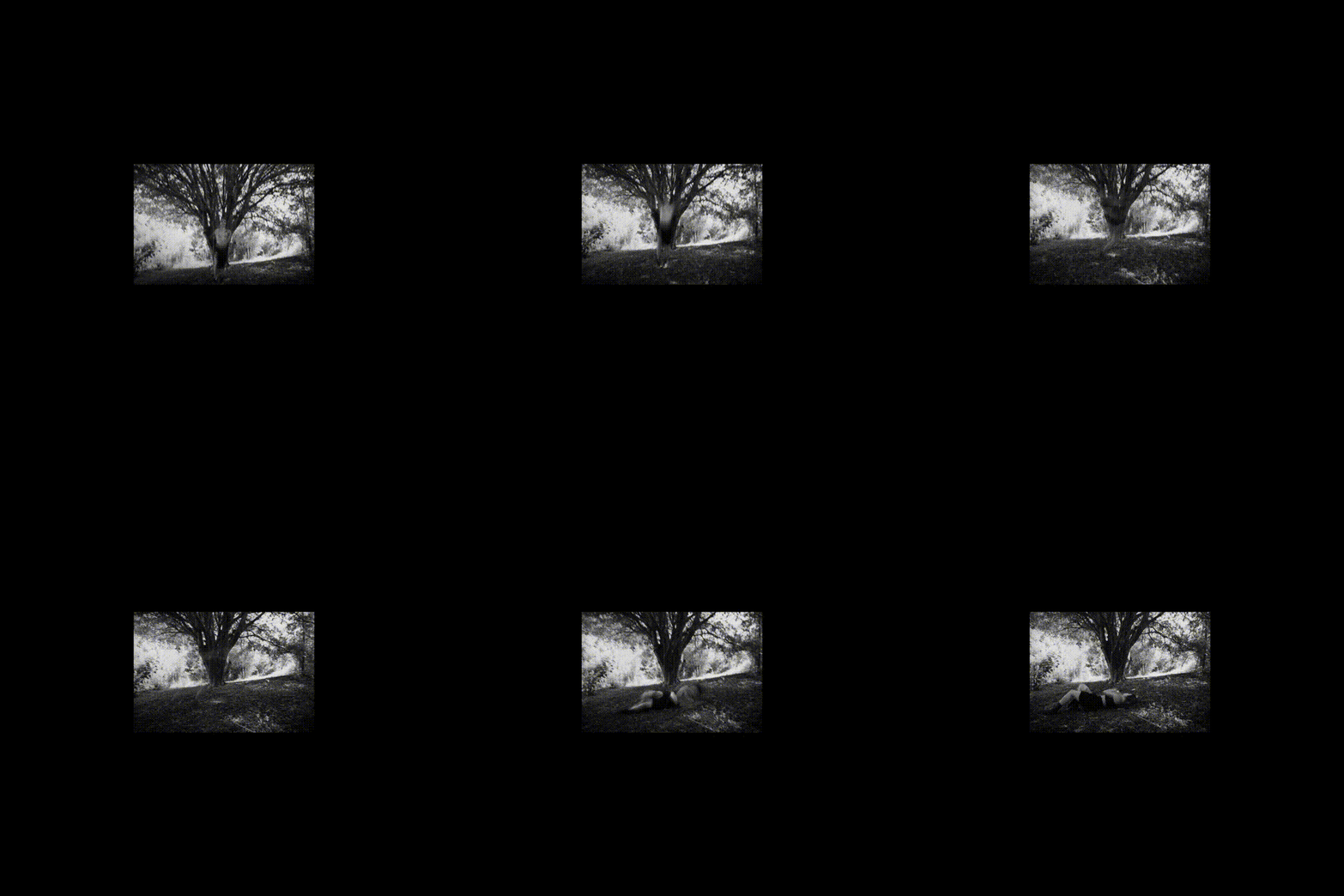
Research
Photographic image methods – and the image itself – play an important role in therapeutic applications in trauma, such as those used in the EMDR technique (Desensitization and reprocessing through eye movements), or those used in Psychodrama techniques or in cognitive and neurological disorders of patients, such as psychotics, whose outbreaks suggest the cause and association of brain damage and chronicity involving memory loss, regardless of the patient's neuroplasticity, thus considering more serious cases such as Alzheimer's disease.
Analyzing the temporality of memory through photography as a method of documenting memories and consequently a desensitizing act because memory, despite being documented, can be subjective and questionable, it is possible to consider the decoding of photography a projection of the mathematical logical linearity of primitive communication, being an evolution of the noise uttered in a primate communication that proceeds the gesture (the performance - characterizing in art) and consequently the image, a technical evolution or the coding of the image.
This project proposes experiments on desensitizing processes using photographs and installations that suggest the recovery of memories. These installations are based on the assumption that communication is intuitive and if we go back to the primitivism of communication, starting from gestures (performance) and noise/symbols (decoding of the documentary photographic image) we can arrive at basic principles of human memory, thus including a dialogue more simplified within pathologies and disorders associated with memory loss, therefore, the development of this research is mainly a parallel alternative, proposing the use of photography in psychiatric, psychological and neurological treatment.


Method
This proposal aims to investigate and artistically translate the experience of memory loss by interviewing individuals with partially lost memories, as well as friends or family members of people who have experienced total memory loss. The goal is to narrate and visualize the stories related to these losses through photography, sound, and immersive installation. Participants will be divided into two specific groups:
- 01Volunteers willing to share personal stories of trauma, which will serve as a basis for a photographic desensitization process using self-portraiture;
- 02Volunteers experiencing specific memory loss, who agree to contribute with personal photographs or emotionally significant objects to be photographed — materials potentially connected to memory loss triggers.
These images will be subjected to a decoding process: the photographic content will be deconstructed into symbolic visual elements, replacing the traditional photograph with abstract representations. Additionally, each decoded image will be translated into sound stimuli using software-generated noise derived from the visual structure of the image itself.
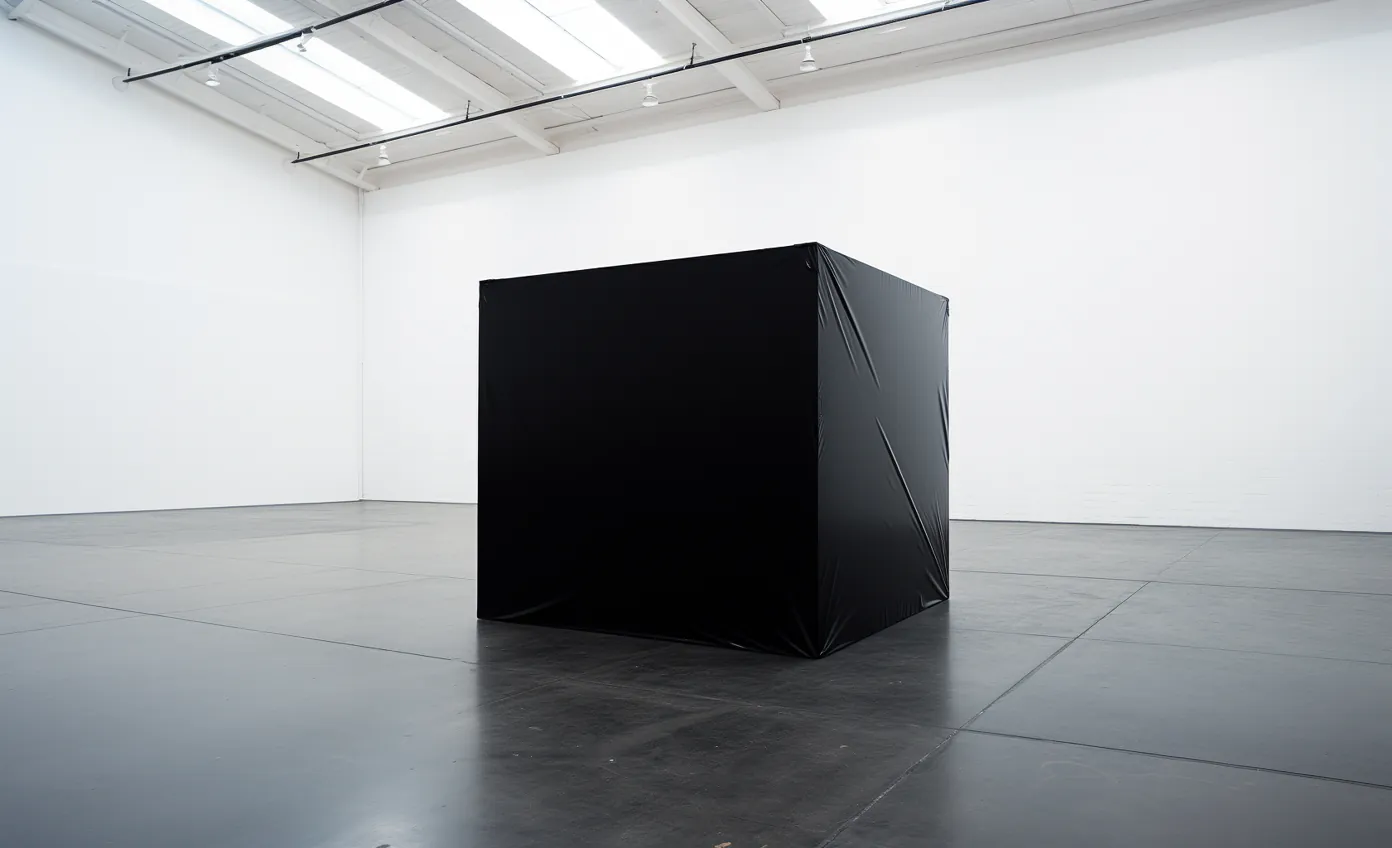
The culmination of this research will take form as an immersive installation titled The Black Box, built in Virtual Reality, simulating a “Camera Obscura”. Visitors will be able to interact with each floating photograph in a fully dark 3D environment. Each image will be accompanied by synthesized soundscapes and concise narrative texts recounting the personal memory loss stories behind the visuals.
The installation will also include an analog “Camera Obscura” equipped with an analog plate reverb system. A metallic surface inside the camera will be fitted with magnetic pickups to capture subtle acoustic reactions generated by light incidence. These faint resonances — caused by the interaction of light with metal — will be amplified and transformed into audible sound. The lighting will be user-controlled, allowing the audience to manipulate intensity, direction, sharpness, and color temperature, thereby modulating the sonic outcomes in real time.


Installation of the Camera Obscura with sound modulator
The main Camera Obscura will have dimensions of 1x1x1 meters. As light is emitted onto an analog plate reverb system, it will produce modulations in the resulting sound waves. The structure will include a sound modulator that reacts in real time to light variations. For the first Camera Obscura, a dedicated support will be built, requiring a space of approximately 3x3 meters.
The light modulation controllers will also be programmed to control sets of sine wave sound frequencies emitted through separate speakers. These frequencies will be arranged to generate binaural beats, aiming to stimulate auditory-induced changes in brainwave patterns.
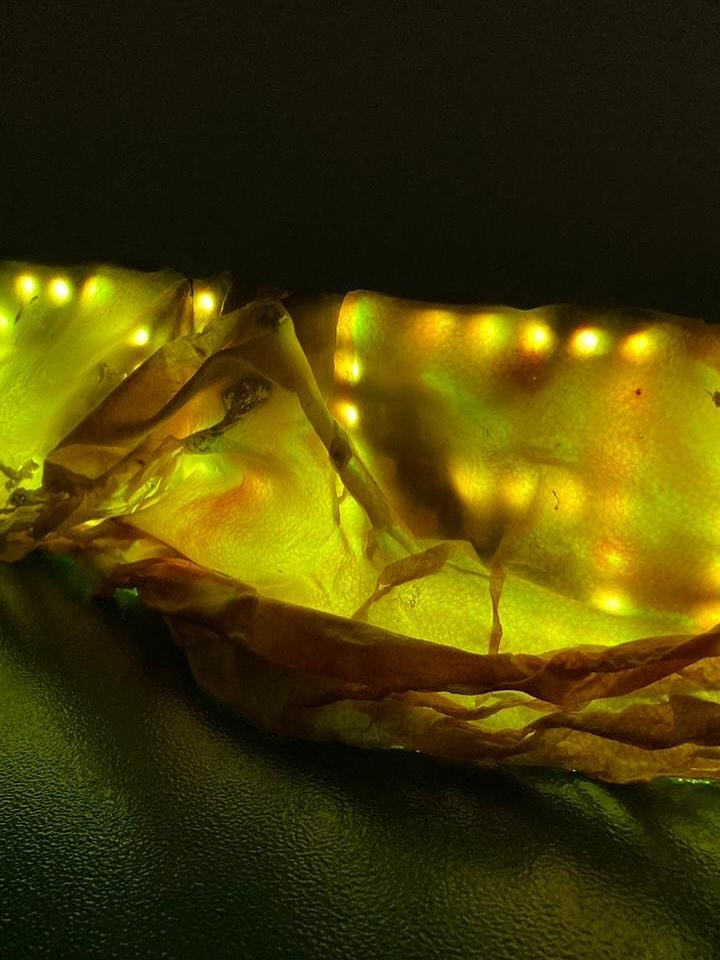
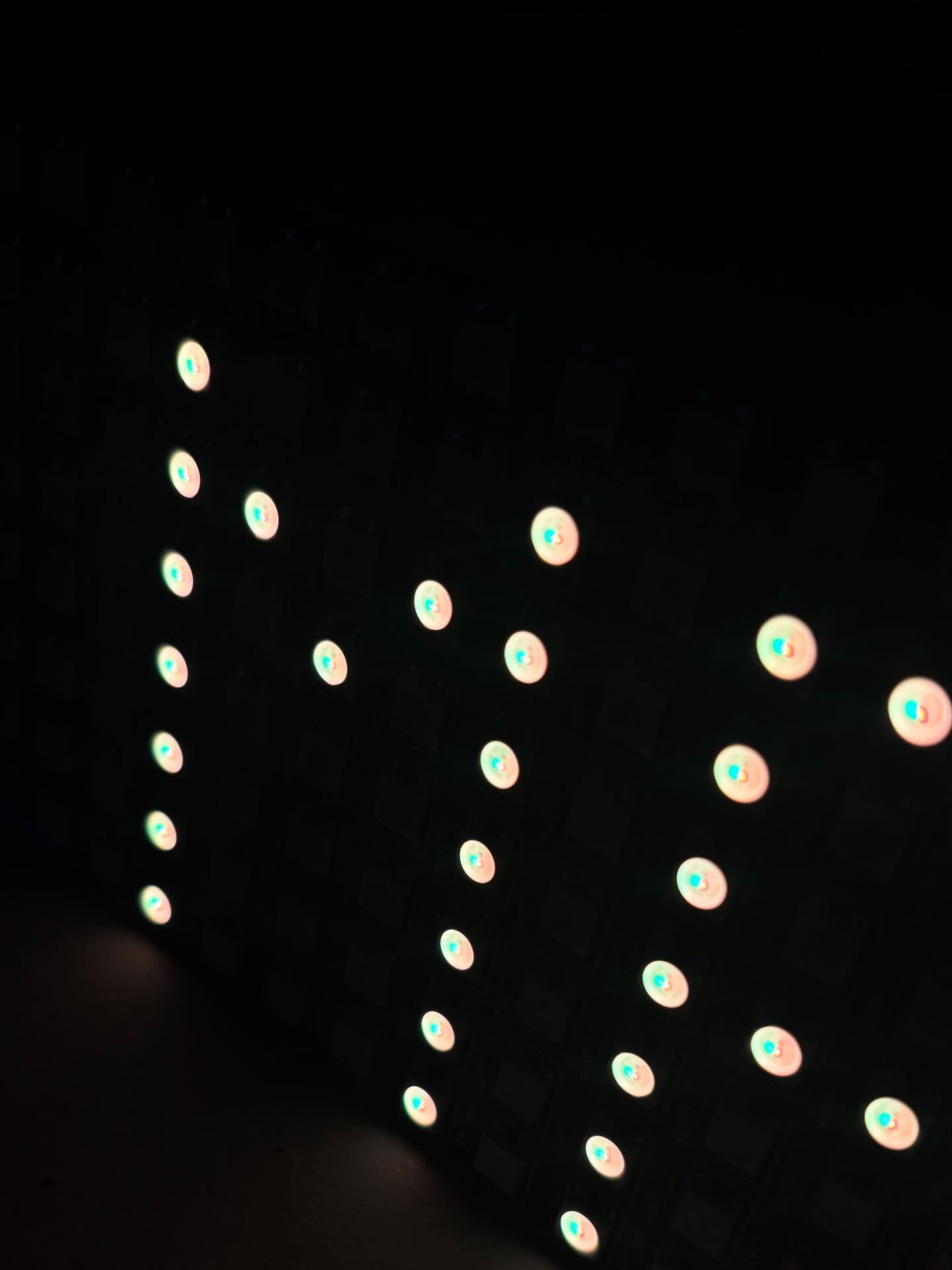
Below, the first prototype
The MEMORY sign, first prototype


Digital Memorial – Site & Database
An immersive website will be developed to allow users who cannot attend the physical exhibition to experience the project remotely. The platform will offer an interactive audiovisual experience combining sound modulation and kinetic art, starting from photographic materials and incorporating elements of physiological optical illusion.
The website will initially collect user interaction data. This data will later activate Mixed Reality Memorials placed in selected public locations across Brazilian cities, triggering light and the emission of specific sound frequencies whenever the digital and physical components align.
Mixed Reality Memorial
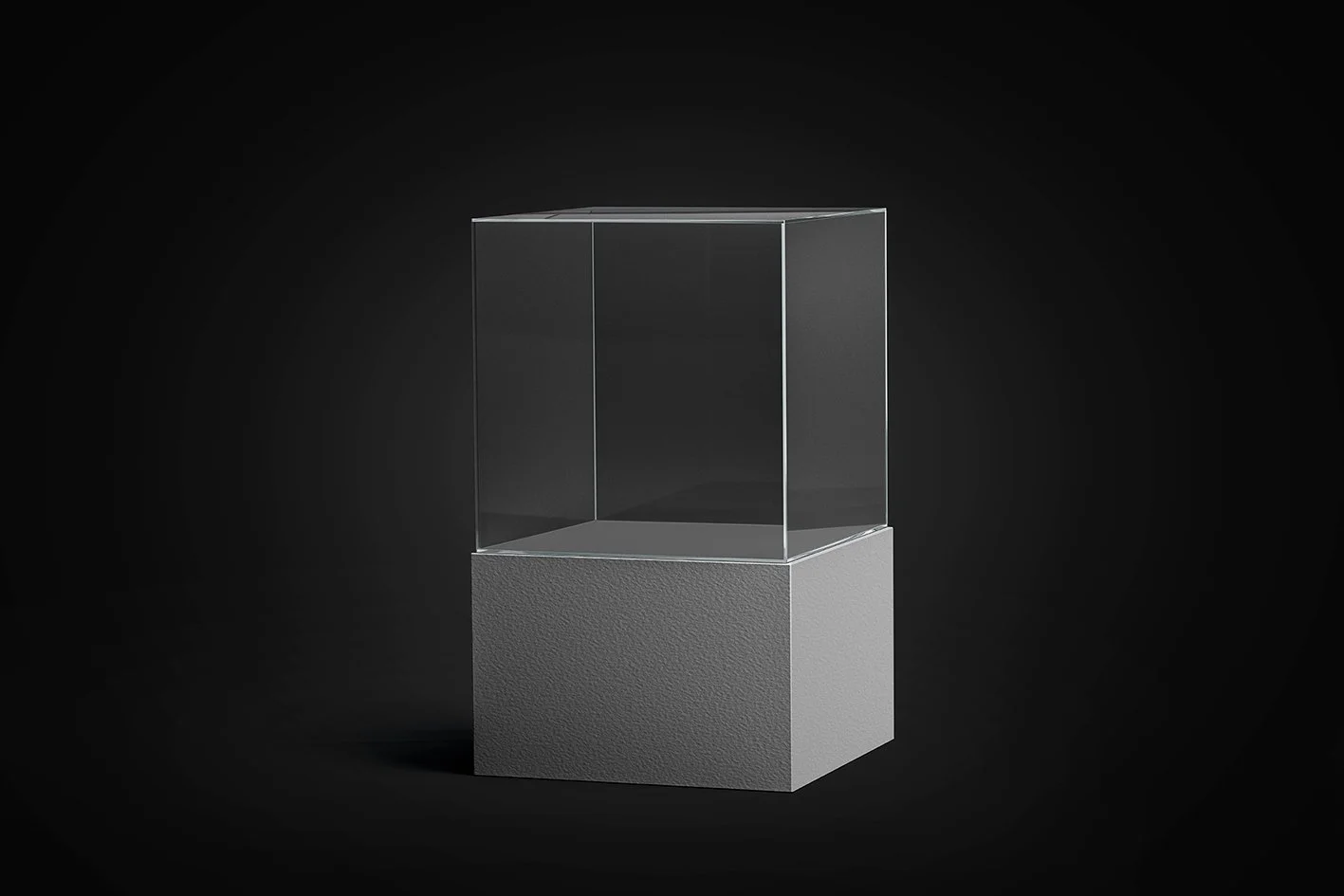
A series of site-specific Mixed Reality installations will be created, designed as “Black Box” structures in urban spaces. These ephemeral memorials will serve as portals for memory reactivation through sound and light. Eventually, these virtual structures will be transformed into physical monuments — tactile and sonic spaces of collective remembrance.
Chapter 02 — Research extension
Archaeology of Futures
An extension of The Camara Obscura research into historical memory, prediction systems and the fabrication of political futures. If The Camara Obscura asks what an image remembers, Archaeology of Futures asks who decides what a society is able to remember, and which futures that memory makes possible.
Counter-archive
- —
Simulated data. In the work, events come from real sources.
Hypothesis
The future is produced by systems that select what deserves to be remembered.
Every prediction contains a politics of memory, and every forgetting changes the field of possible futures.
Societies do not imagine the future from a void. They use past experiences, traumas, historical narratives and cultural repertoires to decide what they consider possible or inevitable. Whoever controls memory also shapes which futures a society is able to imagine.
The research investigates the algorithmic production of futures and the social administration of uncertainty: how statistical models produce scenarios, how governments use predictions to administer populations, how insurers, banks and platforms turn risk into assets, how the anticipation of crises changes behaviour in the present, and how certain groups are systematically represented as future threats. Prediction markets are only one of these infrastructures, alongside surveillance systems and risk models.
Who has the right to speculate on the future of others, and who pays the price when these predictions become instruments of power?
Five layers
- 01The market of the future: infrastructures that turn events into predictions and assets.
- 02The anatomy of money: concentration of resources, volume and timing.
- 03The fabrication of reality: crossing with news, official statements, campaigns and documented events.
- 04Collective anxiety: volatility, speed of information and public perception of threat.
- 05The counter-archive: a permanent record of predictions, events and observed outcomes, including the futures that never happened.
Memory
Institutional and embodied memory
Documentary memory
What was recorded? What was erased? Who had the authority to document?
Collective and traumatic memory
How does a society recognise that a violence may repeat?
Algorithmic memory
What can models remember, and what are they unable to recognise?
Embodied memory
What remains in the body when it disappears from the official archives?
A database can record a dictatorship, a war, an asylum policy or a genocide. But the record is not the experience of those who lived through it.
Neuroscience
Remembering is imagining
The brain uses the same systems to remember the past and to imagine the future (Schacter & Addis). It works as a prediction machine (Friston, Clark), and the anticipation of an uncertain threat mobilises alarm circuits even without present danger (Grupe & Nitschke). Political uncertainty becomes a physiological load, unequally distributed. In the installation, pulse and skin-conductance sensors capture the audience's response, anonymously and without storage, and feed it into the image.
Installation
Three environments
A
The speculated present
A large-scale projection shows the political events being calculated and anticipated at that moment. The data feed the generative system; the audience's pulse alters the image.
B
Futures that did not happen
An archive of past predictions, values, probabilities and historical outcomes. At the central device, the visitor chooses a historical event and follows three temporalities: what happened, what is being anticipated, what may happen.
C
The human cost
Records, documents and testimonies confront abstraction. When a tragedy becomes an asset or a probability, what disappears from the representation?
Method
Correlation, hypothesis, evidence
Every piece of information states whether it is an observed correlation, an investigative hypothesis or proven evidence. Gaps in the archive appear as gaps. No individual is named without public proof. Testimonies are used with informed consent.
References
- Walter Benjamin
- Paul Ricoeur
- Saidiya Hartman
- Ariella Aïsha Azoulay
- Frantz Fanon
- Achille Mbembe
- Brian Massumi
- Louise Amoore
- Schacter & Addis (2007)
- Karl Friston (2010)